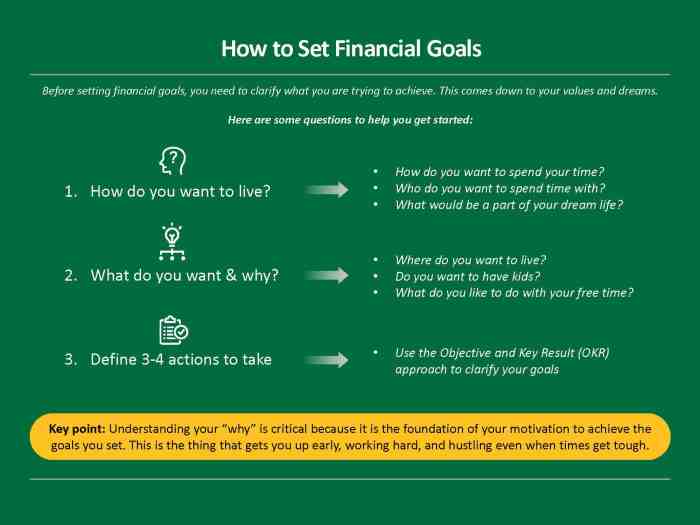
Achieving financial security isn’t about luck; it’s about planning. This guide provides a structured approach to setting and achieving your financial goals, regardless of your current financial situation or life stage. We’ll explore practical strategies for budgeting, saving, investing, and managing debt, empowering you to take control of your financial future.
From defining SMART goals and prioritizing them effectively to understanding various budgeting methods and investment options, we’ll cover all the essential aspects of financial planning. We’ll also delve into debt management strategies and discuss when seeking professional financial advice is beneficial. This guide is designed to be your roadmap to a more secure and prosperous future.
Budgeting and Expense Tracking
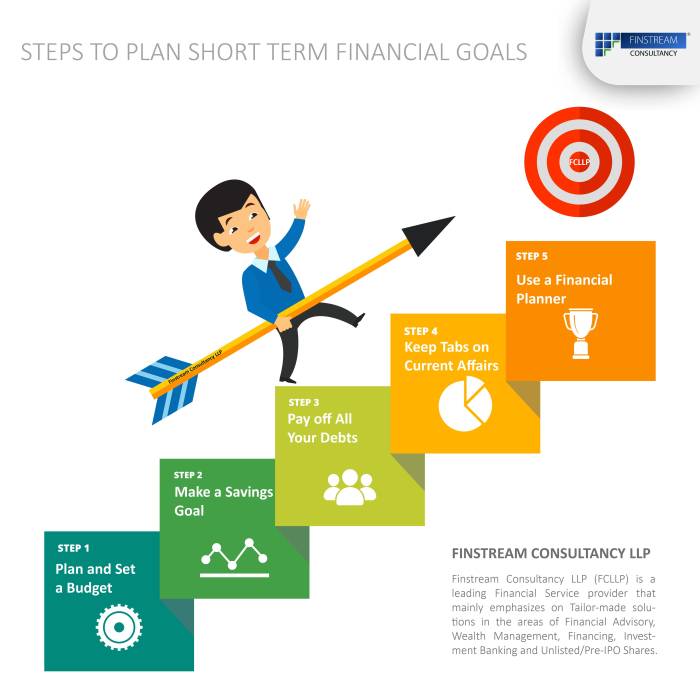
Creating a realistic budget is fundamental to achieving your financial goals. Understanding where your money goes and consciously allocating it towards savings and future aspirations empowers you to take control of your financial future. This section will guide you through the process of building a budget, exploring different budgeting methods, and implementing effective expense tracking strategies.
Creating a Personal Budget
Developing a personal budget involves a straightforward, yet crucial, process. First, meticulously record your income from all sources – salary, freelance work, investments, etc. Next, meticulously categorize your expenses. Common categories include housing, transportation, food, utilities, entertainment, debt payments, and savings. Once you have a clear picture of your income and expenses, you can determine the amount available for savings and debt reduction.
This process should be revisited and adjusted regularly to reflect changes in income or expenses. Remember to be realistic in your estimations; overestimating income or underestimating expenses can lead to inaccurate budgeting. For example, if you usually spend $50 on groceries per week, budgeting $30 will likely lead to unmet needs and potential overspending later.
Budgeting Methods
Several budgeting methods exist, each with its own advantages and disadvantages. Choosing the right method depends on your personal preferences and financial situation. Here’s a comparison of three popular methods:
- 50/30/20 Rule: This method suggests allocating 50% of your after-tax income to needs (housing, food, transportation), 30% to wants (entertainment, dining out), and 20% to savings and debt repayment.
- Pros: Simple and easy to understand; provides a clear framework for spending.
- Cons: May not be suitable for everyone; the allocation percentages may need adjustments based on individual circumstances.
- Zero-Based Budgeting: This method involves allocating every dollar of your income to a specific expense category, ensuring that income equals expenses. Any remaining funds are then allocated to savings or debt repayment.
- Pros: Promotes mindful spending; helps to identify areas where spending can be reduced.
- Cons: Requires more time and effort; can be challenging to maintain consistently.
- Envelope System: This method involves allocating cash to different expense categories (e.g., groceries, entertainment) and placing it in separate envelopes. Once the cash in an envelope is gone, spending in that category stops until the next budgeting cycle.
- Pros: Visual and tangible; helps to control impulsive spending.
- Cons: Less flexible than other methods; may not be suitable for all types of expenses (e.g., utilities).
Expense Tracking Strategies
Effective expense tracking is crucial for understanding your spending habits and making informed financial decisions. There are several ways to track your expenses:Using budgeting apps (Mint, YNAB, Personal Capital) automates the process by linking to your bank accounts and credit cards, automatically categorizing transactions. Spreadsheets (Google Sheets, Excel) offer a customizable approach, allowing you to create your own categories and track your progress visually.
Manually recording expenses in a notebook or journal provides a simple, low-tech option.Regardless of the method chosen, consistent and accurate recording is key. Here are some example expense categories:
- Housing (Rent/Mortgage, Property Taxes, Home Insurance)
- Transportation (Car Payment, Gas, Public Transportation, Parking)
- Food (Groceries, Dining Out)
- Utilities (Electricity, Water, Gas, Internet)
- Healthcare (Insurance Premiums, Medical Expenses)
- Personal Care (Haircuts, Cosmetics)
- Entertainment (Movies, Concerts, Hobbies)
- Clothing
- Debt Payments (Loans, Credit Cards)
- Savings
Saving and Investing
Building a strong financial future requires a well-defined strategy that encompasses both saving and investing. Saving provides a financial safety net and the foundation for future investments, while investing allows your money to grow over time, potentially outpacing inflation and generating wealth. This section will Artikel practical steps to achieve both.
Emergency Fund Plan
An emergency fund acts as a crucial buffer against unexpected financial setbacks, preventing debt accumulation and maintaining financial stability. A commonly recommended target is three to six months’ worth of essential living expenses. The timeframe for achieving this goal depends on individual circumstances and income levels. Someone with a higher income might reach this goal faster than someone with a lower income.
A realistic plan involves setting aside a consistent portion of your income each month, even if it’s a small amount. For example, if your monthly expenses are $2,000, aiming for $500-$1,000 per month in savings would allow you to build a 3-6 month emergency fund within a year or less. Consistency is key; automating your savings through direct deposit into a dedicated savings account can significantly improve the likelihood of success.
Investment Options
Different investment options cater to various risk tolerances and financial objectives. Understanding the risk-reward trade-off is essential for making informed investment decisions. The table below illustrates the characteristics of some common investment options.
| Risk Level | Potential Return | Liquidity |
|---|---|---|
| Low | Low to Moderate | High |
| Moderate | Moderate to High | Moderate |
| High | High to Very High | Low |
Low Risk/Low Return: Savings accounts and Certificates of Deposit (CDs) offer low returns but high liquidity. These are ideal for emergency funds and short-term savings goals.
Moderate Risk/Moderate Return: Bonds offer a relatively stable return compared to stocks, but their returns are generally lower. They are considered less risky than stocks but offer less potential for growth.
High Risk/High Return: Stocks and real estate carry higher risk, but they also have the potential for significantly higher returns over the long term. However, these investments are less liquid and can experience significant price fluctuations.
Mutual Funds: Mutual funds pool money from multiple investors to invest in a diversified portfolio of stocks, bonds, or other assets. This diversification helps to reduce risk. The risk level of a mutual fund depends on the types of investments it holds.
Time Value of Money
The time value of money (TVM) is a core financial concept that emphasizes the increased value of money over time due to its earning potential. A dollar today is worth more than a dollar in the future because of its potential to earn interest or returns through investment. This principle is crucial for long-term financial planning.
The basic formula for calculating future value (FV) is: FV = PV (1 + r)^n
Where: PV = Present Value, r = interest rate, n = number of periods.
For example, if you invest $1,000 today at an annual interest rate of 5% for 10 years, the future value will be approximately $1,628.90. This demonstrates the power of compounding interest over time. Understanding TVM helps in making informed decisions about saving, investing, and borrowing, ensuring that your financial goals are aligned with the potential growth of your money.
Debt Management
Successfully managing debt is a crucial component of achieving long-term financial well-being. High levels of debt can significantly hinder your ability to save, invest, and reach your financial goals. Understanding different debt repayment strategies and practicing responsible credit card usage are key to minimizing the negative impact of debt on your financial future.High levels of debt, particularly high-interest debt, can severely impact your financial health.
The interest payments alone can consume a significant portion of your income, leaving less available for essential expenses, savings, and investments. Furthermore, excessive debt can damage your credit score, making it harder to secure loans, rent an apartment, or even get a job in some cases. Responsible credit card usage involves spending only what you can afford to repay, paying your balance in full each month whenever possible, and monitoring your credit report regularly.
Strategies for Paying Off High-Interest Debt
Effective debt repayment strategies can significantly reduce the time and money spent on paying off debt. Two popular methods are the debt snowball and debt avalanche methods. The debt snowball method focuses on paying off the smallest debt first, regardless of interest rate, to build momentum and motivation. The debt avalanche method prioritizes paying off the debt with the highest interest rate first, to minimize the total interest paid over time.
Choosing the best method depends on individual preferences and financial circumstances. Both methods require discipline and commitment to succeed.
Debt Snowball Method
The debt snowball method involves listing all debts from smallest to largest balance, regardless of interest rate. You then make minimum payments on all debts except the smallest, and put all extra money towards paying off that smallest debt as quickly as possible. Once the smallest debt is paid off, you roll that payment amount into the next smallest debt, creating a snowball effect.
This method can be psychologically rewarding, providing a sense of accomplishment early on, which helps maintain motivation. For example, if you owe $500 on a credit card, $2000 on a personal loan, and $10,000 on a student loan, you’d focus on paying off the $500 credit card debt first.
Debt Avalanche Method
The debt avalanche method focuses on minimizing the total interest paid. You list all debts from highest to lowest interest rate. You make minimum payments on all debts except the one with the highest interest rate, allocating all extra funds towards paying off that debt first. Once that debt is paid off, you redirect those funds to the next highest interest debt.
This method is mathematically more efficient, saving you money on interest in the long run. Using the same example as above, you would prioritize the debt with the highest interest rate first, even if it has the largest balance.
Negotiating Lower Interest Rates
Negotiating lower interest rates with creditors can significantly reduce the overall cost of your debt. Contact your creditors directly and politely explain your situation. Highlight your positive payment history and express your commitment to paying off your debt. Be prepared to propose a specific lower interest rate or a different payment plan. Research competitors’ rates to support your request.
Document all communication and agreements in writing. In some cases, you might be able to consolidate your debts into a loan with a lower interest rate. Success depends on your creditworthiness and the creditor’s willingness to negotiate.
Setting financial goals is a journey, not a destination. By consistently applying the strategies Artikeld in this guide—from creating a realistic budget and tracking expenses to investing wisely and managing debt effectively—you’ll steadily progress toward achieving your financial aspirations. Remember that regular review and adjustment of your plan are crucial for adapting to life’s changes and maintaining your financial well-being.
Take charge of your financial future today!
FAQ Insights
What if I don’t have any savings to start with?
Begin by creating a realistic budget and identifying areas where you can reduce expenses. Even small savings contribute to building an emergency fund over time. Consider starting with a small, achievable savings goal to build momentum.
How often should I review my financial goals?
Review your financial goals at least annually, or more frequently if there are significant life changes (e.g., job change, marriage, birth of a child). This allows you to adjust your plan to reflect your evolving needs and circumstances.
What’s the difference between financial planning and financial goals?
Financial goals are specific targets (e.g., buying a house, retiring at 60). Financial planning is the comprehensive process of creating a roadmap to achieve those goals, encompassing budgeting, saving, investing, and debt management strategies.
How can I stay motivated to stick to my financial plan?
Visualize your goals, track your progress, reward yourself for milestones achieved, and find an accountability partner to support you. Remember the long-term benefits of your efforts and stay focused on your ultimate financial aspirations.