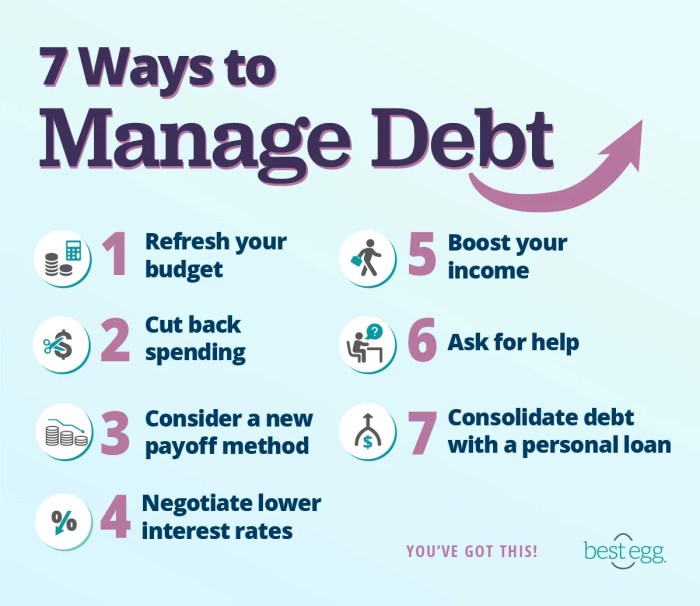
Navigating the complexities of debt can feel overwhelming, but understanding effective strategies empowers you to regain control of your finances. This guide provides practical advice and actionable tips to help you manage your debt effectively, reduce financial stress, and build a more secure financial future. We’ll explore various debt types, budgeting techniques, and debt consolidation options, ultimately equipping you with the knowledge to create a personalized debt management plan.
From understanding the impact of different debt types, like credit card debt and student loans, to developing a personalized repayment strategy, we’ll cover essential aspects of debt management. We’ll also delve into the importance of budgeting, expense tracking, and seeking professional help when needed. This comprehensive approach aims to provide a clear roadmap towards financial stability and long-term well-being.
Understanding Debt
Understanding the different types of debt and their potential impact on your financial well-being is crucial for effective debt management. Ignoring debt can lead to serious long-term consequences, impacting your creditworthiness and overall financial health. This section will explore various debt types and their implications, highlighting the importance of proactive management.Debt, in its simplest form, represents borrowed money that needs to be repaid, usually with interest.
The type of debt you have significantly influences how it impacts your finances and the strategies you need to employ for repayment.
Types of Debt and Their Implications
Different types of debt carry varying levels of risk and interest rates. Understanding these differences is key to making informed financial decisions. For example, high-interest debt, like credit card debt, can quickly snowball if not managed properly, while low-interest debt, such as some student loans, may offer more manageable repayment terms.
- Credit Card Debt: High-interest rates characterize credit card debt, making it expensive to carry. Minimum payments often barely cover the interest, leading to a slow or nonexistent reduction in the principal balance. This can quickly lead to a cycle of debt. For example, a $5,000 balance with a 20% APR can accumulate significant interest charges over time, making repayment significantly more challenging.
- Student Loans: Student loans, while essential for many pursuing higher education, can represent a substantial debt burden. Interest rates vary depending on the loan type (federal vs. private) and the repayment plan chosen. While federal student loans often offer more flexible repayment options, failing to manage them effectively can lead to delinquency and damage to credit scores. For instance, a $50,000 loan with a 6% interest rate could take many years to repay, even with a standard repayment plan.
- Mortgages: Mortgages are long-term loans used to purchase real estate. They generally have lower interest rates than credit cards but represent a significant financial commitment over many years. Missing mortgage payments can lead to foreclosure, a severe consequence impacting credit and housing stability. A 30-year mortgage for a $300,000 home could cost hundreds of thousands of dollars in total interest payments.
- Personal Loans: Personal loans are unsecured loans that can be used for various purposes. Interest rates vary widely depending on the lender and the borrower’s creditworthiness. Careful consideration of the interest rate and repayment terms is crucial before taking out a personal loan, as high interest can quickly make the loan expensive. A personal loan of $10,000 at 10% interest will require significant monthly payments.
Long-Term Consequences of Unmanaged Debt
Failing to manage debt effectively can have severe and long-lasting consequences. These consequences extend beyond just the financial aspect, impacting various areas of life.The most immediate consequence is financial stress. The constant worry about debt repayment can lead to anxiety, depression, and even relationship problems. Furthermore, unmanaged debt significantly impacts your credit score, making it harder to obtain loans, rent an apartment, or even secure certain jobs in the future.
A low credit score can lead to higher interest rates on future loans, perpetuating the cycle of debt. In extreme cases, unmanaged debt can lead to bankruptcy, a significant legal and financial setback. For example, someone struggling with multiple high-interest debts may face difficulty securing a car loan or a mortgage in the future.
High-Interest vs. Low-Interest Debt
The interest rate on your debt significantly influences your repayment strategy. High-interest debt requires aggressive repayment strategies, prioritizing its reduction to minimize accumulating interest charges. Low-interest debt allows for more flexible repayment approaches, although consistent payments remain crucial. Prioritizing high-interest debt repayment, such as paying off credit card debt before focusing on student loans, is often the most effective strategy to minimize the overall cost of borrowing.
For instance, paying extra towards a high-interest credit card will yield greater savings compared to paying extra towards a lower interest student loan.
Creating a Debt Management Plan
Tackling debt effectively requires a structured approach. A well-defined debt management plan helps you regain control of your finances and work towards becoming debt-free. This plan involves careful budgeting, prioritizing debts, and establishing realistic repayment schedules. Negotiating with creditors can also significantly improve your chances of success.Creating a successful debt management plan involves several key steps. These steps, when followed diligently, can lead to a significant reduction in your debt burden and improved financial well-being.
Budgeting and Prioritization
Effective budgeting is crucial for any debt management plan. Start by tracking your income and expenses for at least a month to get a clear picture of your financial situation. Identify areas where you can cut back on spending to free up more money for debt repayment. Prioritize your debts based on interest rates and minimum payments. High-interest debts should generally be tackled first to minimize the overall interest paid.
Consider using the debt avalanche or debt snowball methods to structure your repayment strategy. The debt avalanche method focuses on paying off the debt with the highest interest rate first, while the debt snowball method prioritizes paying off the smallest debt first for motivational purposes.
Negotiating Lower Interest Rates
Negotiating lower interest rates with creditors can significantly reduce the total amount you pay over the life of your loans. Before contacting your creditors, gather all relevant information about your debts, including balances, interest rates, and payment history. Then, politely explain your financial situation and propose a plan for repayment, highlighting your commitment to resolving the debt. Be prepared to negotiate and offer a higher minimum payment in exchange for a lower interest rate.
Many creditors are willing to work with borrowers who demonstrate a genuine effort to repay their debts. Keep records of all communications and agreements.
Creating a Repayment Schedule
Once you’ve prioritized your debts and potentially negotiated lower interest rates, it’s time to create a realistic repayment schedule. This schedule should allocate a specific amount of money each month to each debt, based on your budget and repayment priorities. Ensure the schedule aligns with your budget and lifestyle, avoiding overextension. Regularly review and adjust your repayment schedule as needed, taking into account any unexpected changes in income or expenses.
Consider using debt repayment calculators available online to help you model different repayment scenarios.
Sample Debt Repayment Plan
The following table provides a sample debt repayment plan. Remember that this is just an example, and your own plan will depend on your specific circumstances.
| Debt Type | Balance | Interest Rate | Monthly Payment |
|---|---|---|---|
| Credit Card A | $5,000 | 18% | $200 |
| Credit Card B | $2,000 | 24% | $100 |
| Personal Loan | $10,000 | 10% | $300 |
Budgeting and Expense Tracking
Effective budgeting and diligent expense tracking are crucial for successful debt management. Understanding where your money goes is the first step towards controlling your spending and allocating funds towards debt repayment. By creating a realistic budget and consistently monitoring your expenses, you can identify areas where you can cut back and free up more money to tackle your debt.Creating a budget involves planning how you will spend your money each month.
This involves estimating your income and allocating funds to various categories of expenses. There are several techniques that can help you create an effective budget.
Budgeting Techniques
Effective budgeting involves carefully planning how your income will be allocated across different spending categories. Two popular methods are the 50/30/20 rule and zero-based budgeting.The 50/30/20 rule suggests allocating 50% of your after-tax income to needs, 30% to wants, and 20% to savings and debt repayment. Needs include essentials like housing, food, transportation, and utilities. Wants encompass non-essential items like entertainment, dining out, and shopping.
Savings and debt repayment should prioritize building an emergency fund and paying down debt. For example, if someone earns $4,000 after tax, they would allocate $2,000 to needs, $1,200 to wants, and $800 to savings and debt repayment.Zero-based budgeting involves allocating every dollar of your income to a specific purpose. This requires meticulously categorizing all expenses and ensuring that every dollar is accounted for.
It’s a more detailed approach but can provide a clearer picture of your spending habits. A person using this method would list all income sources and then allocate every dollar to specific expenses, ensuring that total expenses equal total income. Any leftover money would be allocated to savings or debt repayment.
Expense Tracking Methods
Expense tracking involves monitoring your spending to understand where your money goes. Several methods and tools can help with this.Manual tracking involves recording every expense in a notebook, spreadsheet, or using a simple budgeting app. This provides a detailed overview of your spending habits. A simple spreadsheet could have columns for date, description, category, and amount. Categorization (e.g., groceries, transportation, entertainment) helps identify spending patterns.Automated tracking uses apps that connect to your bank accounts and credit cards to automatically categorize and track your transactions.
Many budgeting apps offer this feature, simplifying the tracking process. Mint, Personal Capital, and YNAB (You Need A Budget) are examples of such apps. These apps often provide visual representations of spending habits, making it easier to identify areas for improvement.
Sample Monthly Budget
A sample monthly budget can help illustrate how to categorize income and expenses.* Income:
Salary
$3,500
Side Hustle
$500
Expenses
Needs (50%)
Housing
$1,000
Groceries
$400
Transportation
$200
Utilities
$150
Wants (30%)
Entertainment
$300
Dining Out
$150
Shopping
$100
Savings & Debt Repayment (20%)
Emergency Fund
$100
Debt Payment
$600
Debt Consolidation and Refinancing
Debt consolidation and refinancing are strategies designed to simplify debt management and potentially lower overall borrowing costs. They involve combining multiple debts into a single payment, often with a more favorable interest rate. While both aim for similar outcomes, they differ in their approach and suitability for various financial situations. Understanding the nuances of each is crucial before making a decision.Debt consolidation and refinancing can offer significant advantages, but they also carry potential drawbacks.
Careful consideration of your personal financial circumstances is essential to determine whether these strategies are the right fit for your needs. Improperly implemented, they can lead to further financial difficulties.
Balance Transfers
Balance transfers involve moving high-interest debt from one credit card to another with a lower introductory APR. This allows you to pay down your debt faster by reducing the interest charges during the promotional period, typically lasting 6-18 months. However, it’s crucial to understand that the lower interest rate is temporary. Once the promotional period ends, the interest rate usually jumps to a much higher rate, potentially exceeding the original rate if you haven’t paid off a significant portion of the balance.
Furthermore, balance transfer fees (often a percentage of the transferred amount) can offset some of the initial savings. Successful balance transfers require diligent planning and timely repayment to avoid accumulating additional debt after the introductory period ends. For example, if you transfer a $5,000 balance with a 3% transfer fee, you’ll immediately owe $150 in fees.
Personal Loans for Debt Consolidation
Personal loans can consolidate multiple debts – credit cards, medical bills, or even smaller personal loans – into a single monthly payment. This simplifies budgeting and provides a clear repayment schedule. Personal loans often offer fixed interest rates, providing predictability in monthly payments unlike variable interest rates on credit cards. However, securing a personal loan with a favorable interest rate depends on your credit score and financial history.
A poor credit score might result in a higher interest rate than your current credit card rates, negating the benefits of consolidation. Additionally, personal loans often have origination fees, impacting the overall cost. For example, a $10,000 personal loan with a 7% interest rate and a $200 origination fee will have a higher total cost than a loan with a lower origination fee.
Scenarios Where Debt Consolidation is Most Beneficial
Debt consolidation is most beneficial when it leads to lower interest rates, simplified repayment, and improved financial management. It’s particularly advantageous for individuals with multiple high-interest debts, struggling to manage various payment schedules, or those seeking to improve their credit score through consistent and timely payments on a consolidated loan. For instance, someone with several credit cards charging 20% interest could significantly benefit from consolidating their debt into a personal loan with a lower, fixed interest rate of, say, 8%.
This allows for faster debt repayment and reduces the overall interest paid. However, it’s vital to have a realistic repayment plan in place to avoid further debt accumulation.
Seeking Professional Help
Navigating significant debt can be overwhelming, and sometimes seeking professional guidance is the most effective strategy for regaining financial control. Credit counselors and financial advisors offer distinct yet complementary services that can significantly improve your debt management journey. Understanding their roles and how to access their expertise is crucial for making informed decisions.Professional help offers a structured approach to debt management, often providing tools and strategies unavailable through self-help methods.
A personalized plan, created with the guidance of an expert, can address specific financial circumstances and help individuals develop long-term financial stability. The benefits extend beyond simply reducing debt; they encompass improved financial literacy, stress reduction, and the development of healthy financial habits.
The Roles of Credit Counselors and Financial Advisors
Credit counselors specialize in helping individuals manage and resolve debt issues. They typically offer budgeting assistance, debt negotiation with creditors, and education on responsible financial practices. Financial advisors, on the other hand, provide broader financial planning services, which may include debt management but also encompass investment strategies, retirement planning, and estate planning. While both can assist with debt, a credit counselor focuses specifically on debt resolution, whereas a financial advisor takes a more holistic approach to managing your overall financial well-being.
Choosing between the two depends on your specific needs and the complexity of your financial situation. For example, someone with overwhelming credit card debt might benefit most from a credit counselor, while someone facing a complex mix of debt and investment needs might benefit from a financial advisor.
Seeking Professional Help: The Process and Benefits
The process of seeking professional help typically begins with researching and selecting a reputable agency or advisor. This involves checking credentials, client reviews, and fees. Next, an initial consultation allows you to discuss your financial situation and determine the best course of action. The professional will then work with you to create a personalized debt management plan, which may involve negotiating lower interest rates, consolidating debts, or creating a realistic budget.
Throughout the process, you’ll receive ongoing support and guidance to ensure you stay on track. The benefits include reduced stress, improved financial literacy, a structured plan for debt repayment, and potentially lower interest rates and fees. The structured approach provided by professionals can lead to a more efficient and effective debt reduction strategy compared to attempting to manage debt independently.
Resources for Finding Reputable Credit Counseling Agencies
Finding a trustworthy credit counseling agency is paramount. Several organizations offer resources to help you locate reputable agencies. The National Foundation for Credit Counseling (NFCC) is a good starting point. They offer a directory of member agencies that adhere to their code of ethics. Additionally, checking with your state’s attorney general’s office or consumer protection agency can provide information on registered and accredited credit counseling organizations in your area.
It’s crucial to verify the agency’s credentials and read reviews from previous clients before engaging their services. Always be wary of agencies that promise quick fixes or charge excessive fees upfront.
Preventing Future Debt
Avoiding future debt requires a proactive approach to personal finance, shifting from reactive debt management to preventative financial wellness. This involves cultivating responsible spending habits, building a robust savings plan, and establishing a strong financial foundation. By understanding and implementing these strategies, you can significantly reduce your risk of accumulating debt in the future.
Preventing future debt hinges on a combination of mindful spending, strategic saving, and proactive financial planning. It’s not about deprivation but about making informed decisions that align with your financial goals. This involves creating a budget that reflects your values and priorities, and sticking to it. It also means understanding the difference between needs and wants, and prioritizing accordingly.
Responsible Spending Habits
Developing responsible spending habits involves a conscious effort to track expenses, differentiate between needs and wants, and avoid impulsive purchases. A practical approach is to create a detailed budget that allocates funds for essential expenses like housing, food, and transportation, leaving room for discretionary spending. By tracking expenses diligently, you gain valuable insights into your spending patterns, identifying areas where you can cut back.
For example, analyzing your credit card statements might reveal recurring subscriptions or entertainment expenses that could be reduced or eliminated. Additionally, adopting the habit of delaying non-essential purchases for a predetermined period (e.g., 24 hours) can help avoid impulsive buying.
Strategic Saving Strategies
Saving is crucial for building financial resilience and preventing future debt. It provides a financial buffer to cover unexpected expenses, preventing the need to resort to high-interest debt. A common strategy is to automate savings, setting up automatic transfers from your checking account to a savings account each month. This ensures consistent savings, even when faced with other financial demands.
Consider setting up separate savings accounts for specific goals, such as an emergency fund, a down payment on a house, or retirement. Aim to save a percentage of your income each month, gradually increasing the percentage as your income grows. For example, starting with 10% and increasing to 15% over time is a viable approach.
Financial Habits Checklist for Long-Term Stability
Building long-term financial stability requires consistent effort and discipline. This checklist Artikels key financial habits to adopt and maintain:
The following checklist provides a structured approach to building positive financial habits. Consistent implementation of these steps is crucial for long-term financial success and debt prevention.
- Create and stick to a detailed budget.
- Track expenses meticulously using budgeting apps or spreadsheets.
- Automate savings transfers to a separate account.
- Build an emergency fund covering 3-6 months of living expenses.
- Pay bills on time to avoid late fees and negative credit impact.
- Prioritize needs over wants when making purchasing decisions.
- Avoid using credit cards for non-essential purchases.
- Review credit reports regularly to identify and correct errors.
- Set realistic financial goals (short-term and long-term).
- Seek professional financial advice when needed.
Financial Advice, Auditing, Goals, and Planning
Achieving and maintaining long-term financial health requires a holistic approach that integrates financial advice, regular auditing of your finances, well-defined financial goals, and a robust financial plan. These four elements are interconnected and mutually reinforcing, creating a powerful system for managing your money effectively. Ignoring any one of these aspects weakens the overall structure and increases the risk of financial instability.Financial advice, auditing, goal setting, and planning work synergistically to create a strong financial foundation.
Financial advice provides the knowledge and strategies needed to make informed decisions, while auditing offers a clear picture of your current financial situation. This clear picture then informs the setting of realistic goals and the development of a comprehensive plan to achieve those goals. Regular reviews and adjustments ensure the plan remains relevant and effective over time, adapting to changing circumstances and opportunities.
Financial Auditing Informs Financial Planning and Goal Setting
Financial auditing acts as a crucial diagnostic tool. By analyzing income, expenses, assets, and liabilities, a clear picture of your net worth and spending habits emerges. For example, an audit might reveal that a significant portion of income is allocated to non-essential expenses, hindering progress toward savings goals. This information directly informs the creation of a financial plan by highlighting areas needing improvement.
Realistic savings goals can then be set based on the identified surplus or deficit. Furthermore, if debt is a major issue, the audit will quantify the debt burden, informing decisions on debt consolidation or repayment strategies within the financial plan. A comprehensive audit can also reveal unexpected assets or liabilities that influence the overall financial strategy.
The Importance of Regular Financial Reviews and Adjustments
Life is dynamic. Income fluctuates, expenses change, and unexpected events occur. A static financial plan is unlikely to remain effective in the face of such changes. Regular reviews, ideally quarterly or annually, are essential to ensure the plan remains aligned with current circumstances and evolving goals. These reviews should involve comparing actual performance against the plan, identifying any deviations, and making necessary adjustments.
For example, a promotion leading to increased income would necessitate adjustments to savings targets and investment strategies. Conversely, unforeseen medical expenses might require a temporary reduction in savings contributions and a reassessment of spending habits. The flexibility provided by regular reviews allows for proactive adjustments, mitigating the risk of financial setbacks and maintaining stability.
Visual Representation of Interconnected Concepts
Imagine four interconnected circles, each representing one of the four concepts: Financial Advice, Financial Auditing, Financial Goals, and Financial Planning. Financial Advice sits at the top, providing overarching guidance and direction to the other three. Arrows flow from Financial Advice to each of the other three circles, indicating its influence. Financial Auditing is depicted as feeding information into both Financial Goals and Financial Planning.
The circle representing Financial Goals is linked to Financial Planning, demonstrating that goals drive the creation of the plan. Finally, an arrow loops from Financial Planning back to Financial Auditing, highlighting the importance of monitoring progress and making adjustments based on the ongoing audit of the financial situation. The entire structure is a closed loop, illustrating the continuous and iterative nature of managing personal finances effectively.
Taking control of your debt is a journey, not a destination. By understanding your debt, creating a realistic budget, and exploring various debt management strategies, you can significantly improve your financial health. Remember, seeking professional guidance when needed is a sign of strength, not weakness. With consistent effort and the right tools, you can successfully navigate your debt and build a brighter financial future.
Start today by assessing your current situation and taking the first step towards a debt-free life.
Frequently Asked Questions
What is the difference between debt consolidation and debt refinancing?
Debt consolidation combines multiple debts into a single payment, often at a lower interest rate. Refinancing involves replacing an existing loan with a new one, usually with better terms.
Can I negotiate lower interest rates with my creditors?
Yes, many creditors are willing to negotiate lower interest rates, especially if you have a history of on-time payments or can demonstrate financial hardship. Contact your creditors directly to discuss your options.
What are some signs I need professional help with debt management?
Signs include consistently missing payments, feeling overwhelmed by debt, or experiencing significant financial stress. If you’re struggling to manage your debt independently, seeking professional help is a wise decision.
How long does it typically take to pay off debt?
The time it takes to pay off debt varies greatly depending on factors such as the amount of debt, interest rates, and your repayment plan. A personalized debt repayment plan can help estimate a timeline.